
Palworld breeding combos
Best Palworld Breeding Combos: 10 Useful Pairings
The best breeding combos in Palworld depend on two things: the Pal you want and the parents you can actually keep in your base. A pair that looks short on a chart may be useless when one parent is missing, a self-breeding target needs two copies, or the route spends more Eggs and Cake than your save can support.
Quick answer: which Palworld breeding combos are worth checking first?
For a useful first pass, start with Mossanda plus Rayhound for Grizzbolt, Relaxaurus plus Grizzbolt for Orserk, Penking plus Bushi for Anubis, Mossanda plus Petallia for Lyleen, and Lamball plus Penking for Verdash. These rows are easy to understand because each target has a named parent pair in the local snapshot and the targets cover different player goals.
For rare targets, the table is more of a validation checklist than a shortcut. The snapshot records Jetragon plus Jetragon, Frostallion plus Frostallion, and Blazamut plus Blazamut for those targets. That means you need two copies of the same Pal before the direct relationship is usable; the row does not describe a way to create the first copy from common parents.
Treat a combo as a starting point. Enter the target and your owned Pals into the calculator, set a realistic generation limit, and inspect every intermediate result before you spend Cake. The shortest data relationship is not always the shortest route from your own collection.
- Work: Anubis, Lyleen, and Verdash are useful targets to check when your priority is handiwork, planting, or a compact early-game roster.
- Combat: Grizzbolt, Orserk, Astegon, and Shadowbeak form a practical shortlist for battle-focused planning, subject to the parents you already own.
- Travel and rare targets: Jetragon, Frostallion, and Blazamut appear as self-breeding relationships in this snapshot, so plan for duplicate parents.
- Passive skills: A species relationship can produce the target without guaranteeing Legend, Swift, Artisan, or any other desired passive combination.
- Version check: The local relationship data is dated August 5, 2026. Recheck the in-game result after a patch changes breeding rules or names.
Best Palworld breeding combos at a glance
The table below is a decision shortlist, not a universal ranking. The first five rows emphasize targets with a clear, readable parent pair for a work or combat goal. The later rows show high-value or self-breeding targets where the main practical question is whether your save already has the required parents.
Parent order does not mean male versus female in this table. The game still needs a compatible pair, and the current UI is the final place to confirm assignment and result behavior. If your owned pool does not contain both names, use the calculator to expand the relationship into a multi-generation route instead of forcing the direct row.
| Goal or target | Recorded parent pair | Why start here |
|---|---|---|
| Anubis | Penking + Bushi | A readable work-focused pair and a useful first check when you want Anubis without treating the entire route as a passive-skill plan. |
| Lyleen | Mossanda + Petallia | A direct relationship for a planting and base-work target; compare it with the parents already in your collection. |
| Verdash | Lamball + Penking | A low-complexity early roster pairing in the snapshot, useful for demonstrating how a direct combo differs from a route. |
| Grizzbolt | Mossanda + Rayhound | A clear combat-target relationship that can be checked before you search for a rarer passive combination. |
| Orserk | Relaxaurus + Grizzbolt | A practical combat chain when Grizzbolt is already available; verify whether the intermediate target saves generations in your save. |
| Astegon | Elizabee + Blazamut | A direct high-value relationship in the snapshot, but the parents may make this a late-stage goal rather than an early shortcut. |
| Shadowbeak | Kitsun + Astegon | Useful for a combat or collection plan when Astegon is already secured; otherwise trace the prerequisite route first. |
| Jetragon | Jetragon + Jetragon | The snapshot records self-breeding, so two Jetragon parents are a requirement rather than an optional detail. |
| Frostallion | Frostallion + Frostallion | This is a duplicate-parent check for a rare target, not a common-parent recipe for obtaining the first Frostallion. |
| Blazamut | Blazamut + Blazamut | Use it to plan a duplicate-parent breeding session and to avoid assuming that any two fire Pals produce Blazamut. |
Source boundary: these relationships come from the local palworld-paldex-api snapshot captured on 2026-08-05. The page uses the snapshot for planning and keeps the visible game result as the final authority.
How to choose the best combo for your save
A search for the best Palworld breeding combos is usually a route-planning problem. A static table tells you that a relationship exists; your save determines whether it is cheap, reachable, and worth the Cake. Use the following order so you do not confuse a valid relationship with a practical plan.
Start with the job or result that matters. A work Pal, a combat Pal, and a flying mount should not be judged by the same standard. A pair that reaches a strong species quickly may still be a poor choice if your real goal is a specific passive set, a mount skill, or a base assignment.
When a direct pair is unavailable, switch from reading to tracing. Add the Pals you own, choose the target, and set a generation cap that matches the storage and Cake you can manage. Review the chain one parent pair at a time; a route with one extra step may be easier when it uses common Pals already in your box.

-
1. Define the target job
Write down whether the target is for work, combat, travel, collection, or a passive-skill project. This prevents a broad best-list query from hiding the reason you want the Pal.
-
2. Check the direct pair
Find the target in the table, then compare both parents with the Pals you own. A row is actionable only when you can supply both parents or can deliberately breed them first.
-
3. Separate species from passives
Use the combo to plan the species result. Plan passive inheritance as a second layer because a parent relationship does not guarantee which passive set appears on the Egg.
-
4. Estimate the resource loop
Count the breeding steps, Eggs, Cake cycles, parent slots, and storage space. Keep intermediate Pals marked so a useful carrier is not sold or assigned elsewhere.
-
5. Verify the route in the tool
Enter your owned Pals and target, set a generation limit, and inspect the output. If the route is empty, add a prerequisite Pal or raise the limit instead of assuming the data is broken.
Read combos by player goal, not only by rarity
A good breeding list should help you make a decision. For base work, the useful question is often whether the target improves a specific job and whether the pair fits your current roster. For combat, you may care more about the target species, skill plan, or passive carriers. For travel and rare collection targets, duplicate parents and long prerequisites become the main constraint.
That is why this page groups examples by goal while keeping the data relationship separate from opinion. The local snapshot can support a parent-to-child claim. It cannot prove that one Pal is the strongest build for every player, or that a passive roll will appear on the next Egg.
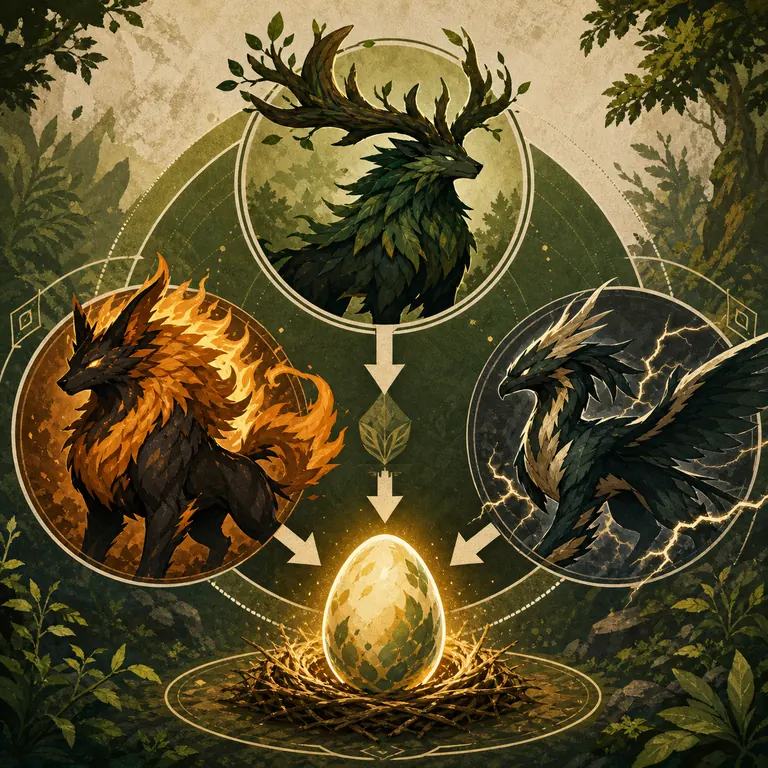
Use the visual examples as orientation, not as a replacement for the table. The Anubis, Jetragon, and Grizzbolt images identify target species; the two concept illustrations explain route thinking and goal selection. They are not official screenshots and do not show live game data.

- Base work: Check Anubis, Lyleen, and Verdash first, then compare the parent availability and the task you need in your current base.
- Combat planning: Use Grizzbolt, Orserk, Astegon, and Shadowbeak as target examples, but keep species selection separate from passive inheritance.
- Travel and rare collection: Expect duplicate-parent or prerequisite questions for Jetragon, Frostallion, and Blazamut; do not read a self-pair row as an early-game recipe.
- Early-game route: A common-parent route can be more useful than a rare direct pair. The calculator is designed to expand from the Pals you actually list as owned.
- Patch discipline: Record the data date beside a route that matters. If the current game UI disagrees with an older chart, prefer the visible current result and revisit the source snapshot.
Why a listed breeding combo may not work for you
A parent pair can be valid in a dataset and still be impractical in a live save. The most common mismatch is not a mysterious failure: it is a missing parent, a self-breeding requirement, a variant-name mismatch, or a route that assumes an intermediate Pal you do not own.
Check the relationship before you troubleshoot the farm. If the pair is valid but no Egg progresses, use the separate farm checklist: assignment, Cake, pathing, storage, and the current in-game work state. A calculator result cannot fix a blocked breeding pen.
Finally, remember that data age matters. This site is an independent fan tool. The source snapshot is useful for planning, but a patch can change relationships, add variants, or alter what the UI calls a parent and child.
- Only one parent is available: Trace that parent as an intermediate target in the calculator or choose another row that matches your owned pool.
- The row repeats the same Pal: Treat it as a two-copy requirement. It describes breeding two copies of the target, not obtaining the first copy from unrelated parents.
- A variant name looks different: Check the exact suffix and element variant shown in the current game. Do not silently substitute a base Pal for a variant.
- The species is correct but the passives are wrong: That is a passive-roll outcome, not necessarily a broken species combo. Move to a passive plan and test multiple Eggs.
- The farm is idle: Open the breeding-farm guide and check the pair assignment, Cake input, walking route, Egg storage, and current status message before changing the combo.

Use the Pal Breeding Calculator to validate a combo
The calculator on this site answers the question that a best-combos list cannot: can your current owned pool reach the target within a manageable number of generations? Choose the target Pal, enter the Pals you already have, and start with a generation cap that leaves room for intermediate parents.
Read the result as a proposed route. Check every edge in the chain, especially when a rare parent appears in the middle. The tool counts the relationship steps in the local dataset and can help estimate Cake cycles, but it does not know your server settings, your storage limit, or the exact passive roll on an Egg.
For a better plan, save the route next to a short note about the target job and the passive goal. That makes it easier to compare two valid pairs: one may be shorter, while the other may use parents you already own or preserve a better carrier for the next generation.

Open the Palworld breeding calculator Review the breeding data method Read the passive skills breeding guide Read the breeding farm guide Palworld breeding chart
Best Palworld breeding combos FAQ
What is the best breeding combo in Palworld?
There is no single best pair for every save. For a practical first check, this page highlights Penking plus Bushi for Anubis, Mossanda plus Rayhound for Grizzbolt, Relaxaurus plus Grizzbolt for Orserk, and Mossanda plus Petallia for Lyleen. The best choice is the valid pair that fits your target and owned parents.
Does Astegon have any good breeding combos in Palworld?
The local snapshot records Elizabee plus Blazamut as a direct Astegon relationship, along with other valid pairs. Because those parents may be late-stage targets, enter your owned Pals in the calculator before treating the direct pair as the shortest practical route.
Do Palworld breeding combos guarantee passive skills?
No. A parent combination describes the species relationship, while passive inheritance and the resulting roll are a separate planning problem. Use the passive-skills guide for trait planning and treat every Egg as a result to verify.
What does combinaciones de crianza de Palworld 1.0 mean?
It is a version-sensitive keyword and label used in recent search data. Do not assume a page or chart marked 1.0 stays correct after later patches. Compare the data date with the current game UI before relying on a route.
Is a Palworld breeding chart the same as the calculator?
A chart usually shows relationships or a large static matrix. The calculator starts from your owned Pals, traces a target route, and applies a generation limit. Use a chart for broad lookup and the calculator for a save-specific plan.
Can I breed Jetragon, Frostallion, or Blazamut with two different Pals?
The local snapshot lists self-pairs for these examples: Jetragon plus Jetragon, Frostallion plus Frostallion, and Blazamut plus Blazamut. That is a duplicate-parent requirement in the dataset, not evidence for a different-parent shortcut.
How many Cakes do I need for a breeding combo?
Plan the Cake requirement around the number of breeding cycles in your route and confirm the current in-game behavior for your settings. A multi-generation route needs more resource planning than one direct pair, and an older fixed number may not apply to every version or server.
Why does my valid pair produce a different result?
First compare the exact parent names and variants with the current data date, then check the farm assignment and Cake state. If the live game disagrees with the snapshot, record the patch and prefer the current visible result while the dataset is reviewed.
Summary: use the combo as a decision starting point
The most useful Palworld breeding combo is not just the pair with the highest rarity or the shortest row on a chart. It is the relationship that reaches your target from parents you can obtain, while matching the job, passive plan, storage, and Cake budget of your save.
Use the shortlist for orientation, the calculator for a save-specific route, and the current game UI for the final Egg result. Keep the August 5, 2026 data snapshot in mind, especially when a future patch changes species, variants, or breeding relationships.
Data source and scope
The relationship table is generated from the site's local snapshot of the public mlg404 Palworld Paldex API dataset. The snapshot was captured on August 5, 2026 and reduced into the parent-pair data used by this calculator. Palworld is an independent fan reference; names and game content belong to their respective owners.
Use the linked repository to review the upstream dataset context, then compare any important route with the current in-game result after a patch. The illustrative images on this page are labelled separately; they are not official screenshots.