
Palworld breeding resource guide
Palworld Breeding Cake: Best Cake, Recipe, and Fast Farming
The short answer is simple: Palworld breeding uses Cake as the farm's resource input, so the best Cake plan is the one that keeps your breeding loop supplied without mixing up ingredients, parents, or Eggs. A Cake in storage does not choose a parent route and it does not change the child's species; it lets the assigned pair continue the farm task.
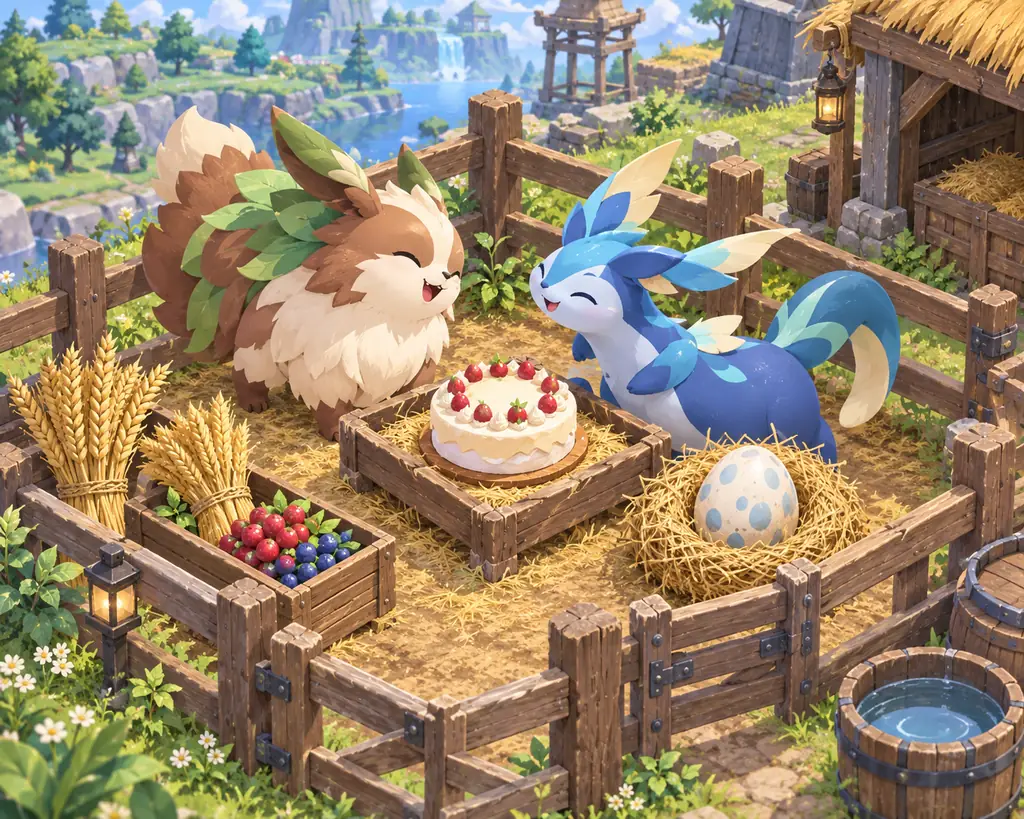
Quick answer: which Cake is best for Palworld breeding?
For a normal breeding farm, use the Cake recipe your current game version exposes and keep finished Cakes in the farm's expected storage slot. Search results often phrase this as “palworld best cake for breeding,” but there is not a separate combat Cake that produces a stronger child. The practical choice is a reliable supply route: Wheat becomes Flour, then Cake is cooked with the other listed ingredients and moved to the pen before you assign a long session.
Plan one Cake per breeding result as a working stock estimate, then confirm the next in-game task before committing a large batch. The site's calculator can find parent chains, while the Cake workflow handles the resource that allows the farm to run.
- Use the current recipe: Read the live cooking or technology menu in your save; older screenshots may show a different ingredient name or workstation.
- Keep a buffer: Prepare more than the exact count when you are testing a route, because a failed assignment or an extra generation can consume the next Cake.
- Separate decisions: Cake keeps the farm task supplied; it does not replace a breeding combination chart, passive plan, or Egg incubator guide.
- Check the slot: Put Cake where the farm can reach it and verify the breeding status after assigning both parents.
Open the Palworld breeding calculator Read the Palworld breeding farm guide
Palworld breeding Cake recipe and ingredients
The familiar Cake ingredients are Wheat Flour, Red Berries, Milk, Egg, and Honey. The exact production chain starts with the resources your world can currently provide: Wheat must be grown and milled into Flour, while Milk, Eggs, Honey, and Berries need a repeatable collection plan. Treat the table as a planning checklist rather than a promise that every server setting uses identical numbers.
A useful supply route has two layers. First, make sure the farm can produce or collect each ingredient without taking the same Pals away from breeding. Second, cook a batch at a suitable cooking station before you assign parents. This prevents the common failure where the pen looks ready but the Cake input is empty.
| Ingredient | Planning source | What to check |
|---|---|---|
| Wheat Flour | Wheat plantation, then a mill or current equivalent | Keep a small reserve of Wheat so one missing harvest does not stop the next batch. |
| Red Berries | Berry plantation or collected stock | Use a dedicated storage row when several farms share the same base. |
| Milk | A Milk-producing Pal or current supply source | Confirm the Pal remains assigned to the supply job rather than the breeding pen. |
| Egg | Collected Egg stock or a current compatible source | Do not sell the parent or intermediate Egg stock by accident. |
| Honey | Honey-producing Pal or current source | Check the live item description because source availability can change. |
The recipe and ingredient quantities are version-sensitive. Verify the current in-game recipe before a large craft, then record the patch date beside your stock plan.
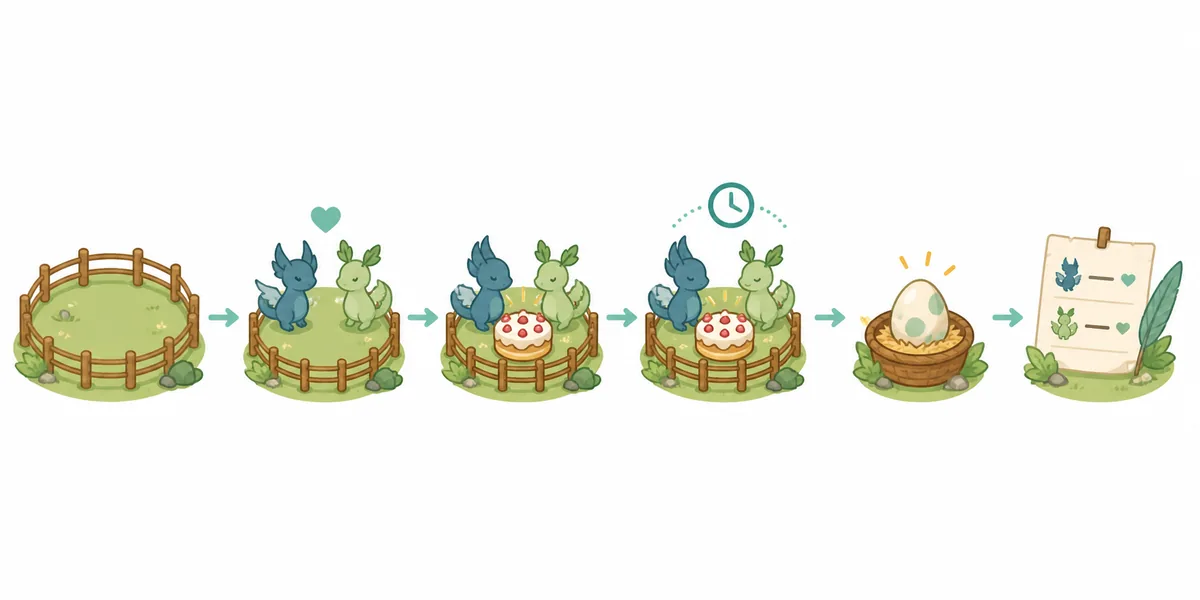
How to make fast Cakes for breeding in Palworld
The fastest route is usually a stable loop, not a single clever workstation. Grow Wheat, convert it to Flour on a predictable schedule, keep the other four ingredients in one reserve, and cook several Cakes before starting a breeding chain. If you only craft after the pen stops, every interruption becomes a pathing and inventory problem at the same time.
Use the workflow below when you are testing a new route. It works for a short two-Pal experiment and scales to a larger base because each checkpoint has one job. Avoid changing parents, Cake supply, and farm layout in the same test; otherwise you cannot tell which change fixed or caused the delay.
-
1. Count the planned breeding results
List the target Pal and each intermediate step from the calculator. Start with one Cake per expected result, then add a small buffer for retries or an extra generation.
-
2. Build the ingredient reserve
Collect Wheat, Berries, Milk, Egg, and Honey before the first long session. Keep parent Pals and ingredient producers in separate assignments so the farm does not silently lose a worker.
-
3. Convert Wheat into Flour
Run the current mill or equivalent as soon as Wheat is ready. Flour is the ingredient most likely to expose a weak upstream plantation, so watch that step before you blame the breeding pen.
-
4. Cook a batch, not one emergency Cake
Cook enough Cakes for the planned chain and label or separate the finished stock. A batch lets you see whether the recipe and workstation are behaving before a parent is waiting in the pen.
-
5. Move the stock to the farm
Put Cake in the storage location the farm can use, then assign one male and one female. Wait for an active work state before adding more Pals or building a second pen.
-
6. Refill after each Egg
Collect the Egg, log the parent pair, and check the remaining Cake count. Refill before the next result rather than discovering an empty slot after a long idle period.
Where to put Cake in a Palworld breeding farm
Cake belongs in the farm storage input that the current interface identifies for breeding. The exact button label may vary by language or update, but the decision is the same: the Cake must be reachable by the farm's work loop. Dropping a Cake on the ground, placing it in an unrelated chest, or leaving it in your character inventory does not prove that the breeding task can consume it.
Keep the Cake input close to the pen entrance and leave a clear walking lane. A good layout makes three states visible from one angle: both parents are assigned, Cake remains in the input, and finished Eggs have somewhere to go. For blocked workers or missing progress, use the farm guide's pathing checklist before replacing a valid parent pair.
- Input first: Use the farm's expected Cake storage rather than a general base chest unless the current UI explicitly links that chest.
- Keep paths open: Do not hide the input behind walls, stacked furniture, or a narrow doorway that can trap an assigned Pal.
- Separate finished Eggs: Move Eggs away from Cake and parent storage so a full or confusing container does not look like a recipe failure.
- Test one pen: Prove one complete Cake-to-Egg loop before copying the layout to multiple farms.
How many Cakes do you need for breeding?
There is no useful universal stock number because the answer depends on the number of Eggs, intermediate Pals, failed assignments, and world settings in your plan. For a quick estimate, count every breeding result in the parent chain and start with one Cake for each result. Add a small reserve if you are learning the route or if the game version has recently changed.
The calculator separates route planning from the Cake estimate. Write the route first, count the outputs, then craft. This avoids buying or cooking a large pile for a direct pair that your owned Pals cannot actually support.
| Plan | Starting stock | Reason |
|---|---|---|
| One direct result | 1 Cake plus a test buffer | Confirms that the pair, input slot, and Egg collection loop work. |
| Three-result chain | 3 Cakes plus a small reserve | Covers two intermediate results and the target result. |
| Long route or passive test | One per result, then refill in batches | Keeps a failed assignment from stopping the whole chain while you record outcomes. |
| Multiple farms | Separate stock by pen | Makes it easier to see which farm consumed a Cake and which one is blocked. |
This is a planning estimate, not a fixed official capacity or drop-rate claim. Check the live farm state and recipe after every patch.
Why is the breeding Cake not working?
When two Pals are assigned but no Egg appears, inspect the resource loop before changing the target. A Cake guide can confirm ingredients and placement, but it cannot fix a missing parent, a blocked route, a full collection area, or a data mismatch. Check one variable at a time and note what the in-game status actually says.
If a recipe looks different from this page, trust the current game menu and record the date. Community guides and screenshots are useful references, but they may describe another patch, platform, or custom server setting.
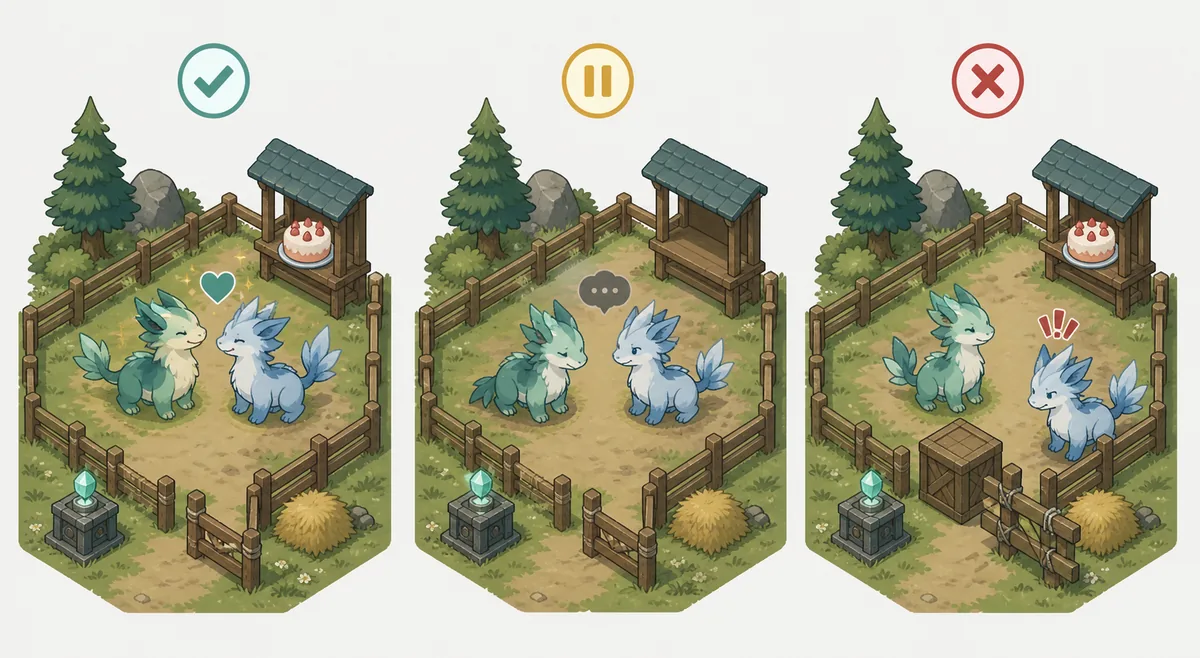
- Cake is not consumed: Move one finished Cake into the farm input, confirm the slot is the one named by the current UI, and watch the work state for a short interval.
- Ingredients cannot be crafted: Trace Wheat to Flour first, then check Milk, Egg, Honey, and Berries. A missing producer assignment can look like a breeding bug.
- Parents leave the pen: Clear the approach and reassign one Pal at a time. Use the farm guide for pathing and base-work troubleshooting.
- The chain uses too many Cakes: Count intermediate results again. One target can require several Eggs when the chosen parents are not directly available.
- The result differs from a chart: Compare the chart's snapshot date, variant names, and current game UI. Use the site's calculator as a route aid, not as a guarantee about passive rolls.
Palworld breeding Cake FAQ
What Cake do you use for breeding in Palworld?
Use the Cake recipe shown by the current game version and place the finished Cake in the breeding farm's expected input. There is not a separate stronger Cake for a stronger child; the Cake supplies the farm task.
How do you make fast Cakes for breeding in Palworld?
Create a repeatable loop for Wheat and Flour, keep Milk, Eggs, Honey, and Red Berries in reserve, and cook a batch before assigning parents. Keep the ingredient producers separate from the breeding pair when possible.
How many Cakes do you need for one breeding Egg?
Use one Cake per planned breeding result as a starting estimate, then confirm the current in-game behavior. Add a small buffer for retries, extra generations, or a newly discovered intermediate Pal.
Where do you put Cake in the breeding farm?
Put it in the farm storage or input slot named by the current interface. A general chest or character inventory may not count, so verify that the farm's active work state can consume the Cake.
Does Cake change the Pal that hatches?
Cake enables the breeding loop; the parents and the current breeding rules determine the result. Use the calculator for parent routes and the passive-skills guide for inheritance planning.
Why is my Palworld breeding farm empty even with Cake?
Check parent assignment, pathing, the active Cake input, Egg collection space, and the current data snapshot in that order. Cake alone cannot fix a worker that cannot reach the pen.
Palworld breeding Cake checklist
A dependable Cake plan has four parts: verify the current recipe, maintain each ingredient source, place finished Cake in the farm input, and count the outputs in your breeding route. Start with one complete Cake-to-Egg test, then scale the batch only after the parents, paths, and collection space are visible and stable.
Use the breeding calculator when the question is which parents can reach a target. Use this page when the question is how to keep the farm supplied. Keeping those decisions separate makes a long breeding chain easier to audit after a Palworld update.
Open the Palworld breeding calculator Find breeding combinations Check egg incubator timing Browse the breeding chart
Sources and update note
This is an independent fan guide. Palworld item names and rules can change. Verify the live recipe and farm behavior in your current save, then use the linked source pages to check the public data snapshot and official game context.