
Quick answer: what makes a Palworld breeding combo best?
A Palworld breeding combo is best when it solves the next decision in your save file with the least waste. For a new base, that can mean a worker you can obtain quickly. For a late project, it can mean a rare target that accepts clean passives without rebuilding the entire line.
Use the Palworld breeding combos search to confirm exact parent pairs, but judge the result with four filters: parent availability, child role, passive inheritance quality and patch-version confidence. A famous pair that requires two hard captures and carries six unwanted passives can be worse than a slower route built from clean parents you already own.
This page is a decision guide, not a replacement for the live table. Start here to choose the type of combo worth pursuing, then open the calculator or breeding tree planner to verify the exact route in the current data set.
Species results are deterministic for an exact pair, but passives, IVs and gender are not. A best-combo shortlist should reduce failed batches, not promise a perfect egg.
9 best Palworld breeding combo types to prioritize
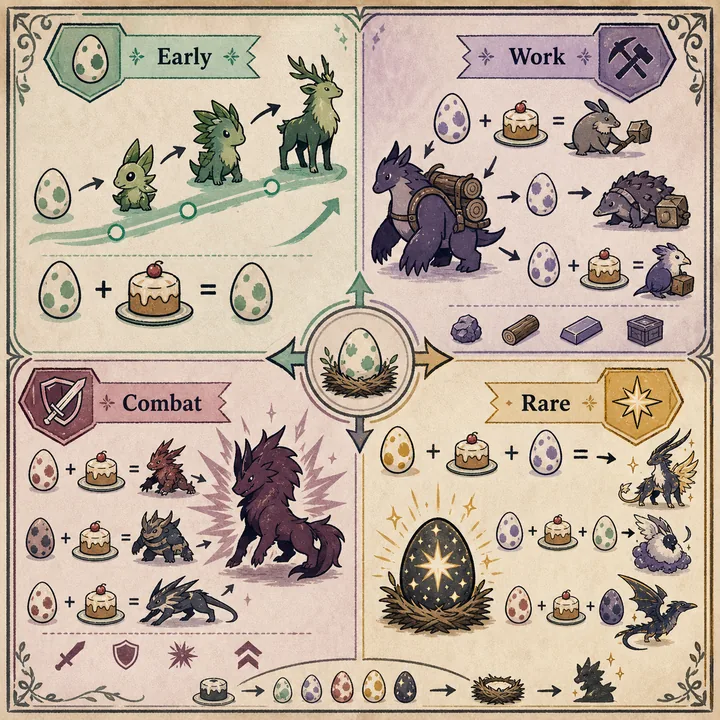
Instead of copying a single universal list, sort Palworld breeding combos by the job the child will perform. The same parent pair can be excellent in one save and inefficient in another if your available parents, passives and cake supply are different.
The table below gives a safer shortlist framework. Use it before you spend cake on a long chain, then verify the exact target in the current combo table.
| Combo type | Best for | What to check before scaling |
|---|---|---|
| Early utility child | Unlocking a useful worker or mount before your base is stable. | Parents are easy to recapture and the child does not require a long passive line yet. |
| Worker passive carrier | Moving work-speed traits toward a final base Pal. | At least one parent has a clean pool with few unrelated combat passives. |
| Combat passive carrier | Consolidating attack, cooldown or element traits before the final species. | The carrier can breed forward without forcing a weak or noisy final parent. |
| Rare target route | Anubis, Orserk-like goals or late-game targets where direct parents are limited. | Current v26 result is verified and the old chart you found is not pre-1.0. |
| Variant-aware combo | Pals whose ordinary and variant forms have different entries. | Names, variants and gender-specific cases are selected exactly. |
| One-parent mate search | You already own one excellent parent and need compatible mates. | The fixed parent does not carry too many unwanted traits. |
| Owned-box combo | Finding what your current Pal box can make today. | The result is useful enough to hatch now rather than just interesting. |
| Bridge generation | Creating an intermediate child that unlocks a better target route. | The bridge child has a clear next job and enough box space to preserve it. |
| Verification batch pair | Testing whether a recommended route is still current. | One egg confirms the species before you invest in mass production. |
Best combos for early progress, workers, combat and rare targets
For early progress, the best breeding combo is usually the one that turns common parents into a child that improves movement, gathering or base coverage quickly. Do not over-optimize four-passive perfection at this stage; a usable child now can support cake production and future captures.
For worker projects, prioritize clean passive transfer over shortest species distance. If a parent already carries Artisan, Serious, Work Slave or another desired work trait without unrelated combat passives, an extra bridge generation may save many failed eggs later. The passive skills guide explains why fewer parent traits usually means clearer inheritance.
For combat projects, decide whether the child needs general damage, element-specific bonuses, cooldown reduction, movement or survivability. A combo that produces the target species with noisy worker traits is not automatically better than a carrier route that preserves the combat pool.
For rare targets, verify current data before trusting a popular screenshot or older article. The site already documents examples where familiar Palworld 1.0 routes changed: Bushi plus Penking no longer serves as an Anubis shortcut in the current v26 data, and the old Relaxaurus plus Grizzbolt Orserk route no longer returns Orserk here.
- Use Anubis breeding combinations when the target is Anubis and you want current parent examples.
- Use Orserk breeding for the version-sensitive Orserk route boundary.
- Use Rayhound breeding combos for a focused example of comparing many valid pairs by practicality.
How to verify a recommended combo before spending cake
Every best-combo recommendation should end with a small verification batch. This is especially important after a major patch, when new eligible Pals, variants or special combinations can change familiar advice.
Run the pair through the calculator, hatch one egg, then write down the exact parent names, variants, genders when relevant, child result, data version and the passives that appeared. If the species is wrong, stop and diagnose the pair before adding more farms. If the species is right but the passives are noisy, refine the parent pool before scaling.
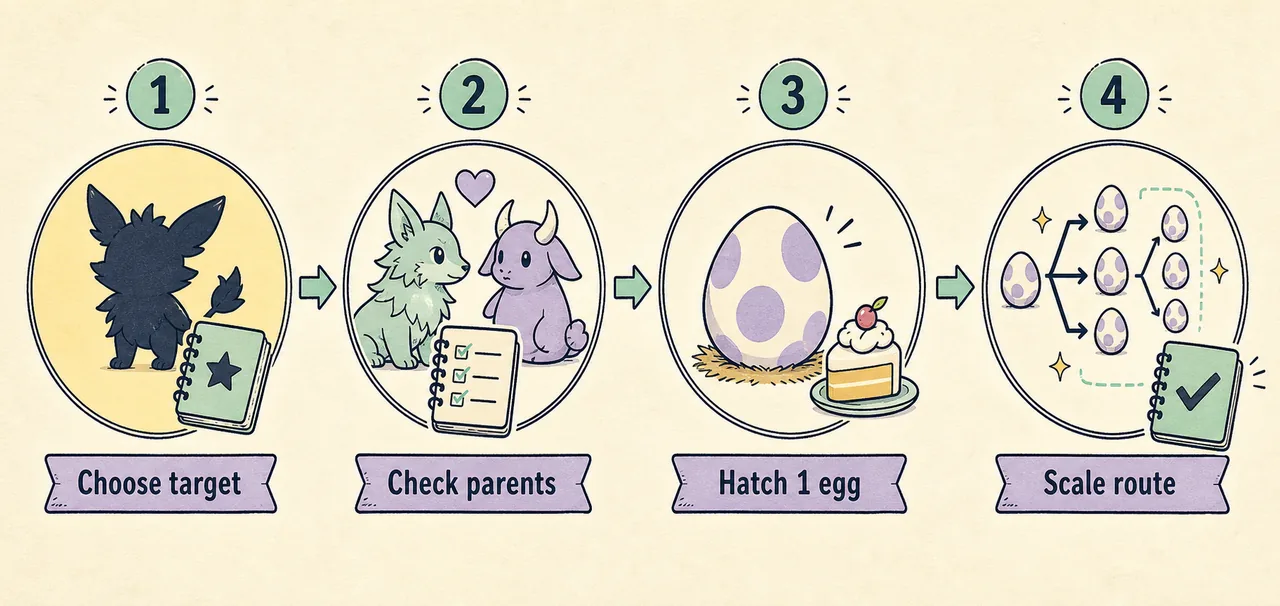
- 1Choose the role first
Decide whether the child is for early utility, work, combat, a rare target or a bridge route.
- 2Confirm exact parents
Search the current combo table and check variants instead of relying on a name-only chart.
- 3Hatch one egg
Use one verification egg to confirm the species result before committing a full cake queue.
- 4Scale only after the result is clean
Increase farms and incubators after the parent pool produces useful hatches, not before.
When a best combo should stay a FAQ or support section
Some keywords look related but do not deserve a separate page. A narrow question such as how many eggs a breeding farm can hold is better as a breeding farm FAQ or support paragraph. A query about changing passive skills belongs inside the passive guide unless it needs a full troubleshooting workflow.
That is the same rule you should use in game planning. If a combo answers one small uncertainty, record it as a note. If it changes the route, the parent pool and the resource plan, give it a dedicated project label and verify it like a full breeding line.
This guide targets best-combo selection. The existing combos page remains the full database search, and individual Pal pages remain the better home for species-specific parent rows.